




How Long Should My Fly-Fishing Leader Be?
There is no magic leader length that suits every form of fly fishing. The important job of the leader is to put distance between the thick, visible fly line and the fish without spoiling presentation.
Choose the leader to suit the method you are fishing. Its job is to separate the fly from the conspicuous fly line while still allowing the cast and presentation to work properly.
A fly line needs weight and mass if it is going to cast properly. That inevitably makes it relatively thick and conspicuous in the water. Put the fly directly on the end of it and you risk alarming the very fish you are trying to catch.
The leader solves that problem. It is the thinner length of fishing line attached between the fly line and the fly, providing the separation needed to make the business end of the tackle much less obvious to the fish.
Why isn't there one correct length?
The leader has to perform more than one job, and different fishing methods place different demands on it. Sub-surface fishing, dry-fly fishing and fishing more than one fly all require slightly different thinking. That is why it is more useful to understand what the leader is doing than to memorise one supposedly perfect measurement.
Keeping the fly line away from the fish
The first purpose of the leader is simple: distance. The fly line is thick because it needs sufficient mass to cast the fly. The leader provides a much finer connection between that line and the fly, helping to prevent the fly line itself from spooking the fish.
Fishing a team of flies
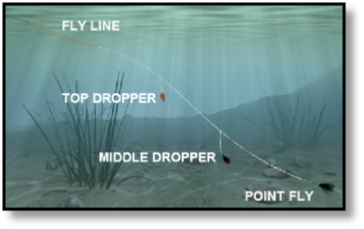
In sub-surface fishing it is common to fish more than one fly. A traditional arrangement is a team of three, with flies spaced down the leader. The flies need not all do the same job. An attractor pattern nearest the fly line may first catch a fish's attention, followed by patterns that provide more convincing food items as the leader is retrieved.
This is another reason why leaders are often prepared as complete assemblies rather than simply treated as an arbitrary length of monofilament.
Dry-fly leaders need different qualities
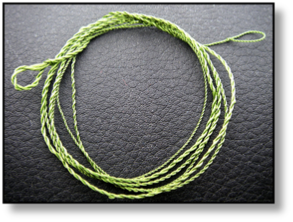
Dry-fly fishing introduces another consideration: turnover. A furled leader is progressively thinner from one end to the other, and that reduction in thickness helps transfer energy down the leader so that it turns over properly and presents the fly.
Leader material matters too. Fluorocarbon sinks quickly, which may be desirable for sub-surface methods but can cause problems with a floating dry fly. Monofilament behaves differently at the surface, so the choice of material should be matched to the method as well as the leader's construction.
The useful rule
Rather than asking for one universal number, ask what the leader needs to achieve in the fishing situation in front of you. It should keep the conspicuous fly line away from the fish, allow the flies to be presented properly and suit the particular method you are using.
Want to go deeper? The Fly Fishing Encyclopedia app contains a fuller section on leaders, teams of flies, furled leaders and the different requirements for dry-fly and sub-surface fishing.
GET THE APP HERE